
Details
- ERC sector
- PE5 - Synthetic Chemistry and Materials
- ERC subsector
- PE5_17 - Organic chemistry
- Project start date
- CUP
- D53D23010030006
- Financial support received
- €67.931,00




SAMBA seeks to develop an innovative bottom-up strategy to create multifunctional materials that can selectively recognize a target bacterial strain, signal its presence, and release antibiotics. The originality of the approach lies in: i) the tailored size and morphology of the carriers; ii) the use of multivalent ligands for selectivity; iii) the incorporation of multiple fluorophores for enhanced sensitivity; iv) the high antibiotic loading capacity; and v) the stimulus-triggered drug release.
Website: https://scvsa-servizi.campusnet.unipr.it/do/progetti.pl/Show?_id=ca2i
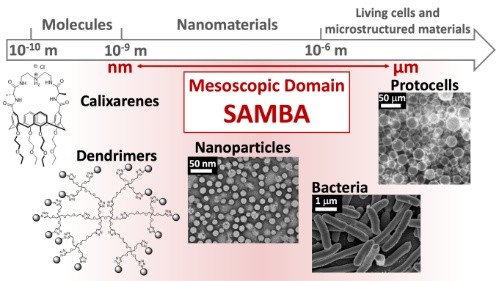
The SAMBA Project is pioneering new self-assembled antibacterial materials to tackle one of the biggest health threats of our time: antimicrobial resistance. With cutting-edge diagnostic tools, SAMBA will rapidly identify whether an infection is caused by Gram-positive, Gram- bacteria, or myco-bacteria. At the same time, its smart delivery systems will release antibiotics precisely at the site of infection—using lower doses, working more effectively, and protecting the body’s natural microbiota.
It is expected to identify at least one class of multivalent ligands able to selectively recognize one of the three major classes of bacteria (Gram-positive, Gram-negative or mycobacteria). The incorporation of such ligands onto self-assembled nano-objects (NOs) or cell-like micro-compartmentalised systems (protocells) will allow to obtain vectors for fluorescent probes and drugs that selectively sense and kill the target class of bacteria.
Researchers have identified a new class of calixarene ligands that can specifically recognize Gram-negative bacteria by binding to their lipopolysaccharides (Small Structures 2025). These ligands are being tested in sensors to detect bacteria, and when attached to nano-objects, they could serve as smart carriers to deliver antibiotics directly and selectively to the target bacteria.